Does the Law of Reflection Apply to All Surfaces
Does the law of reflection apply to all surfaces. The dashed line is called the normal drawn at 90 to the surface of.

The Law Of Reflection Physics
B8eautri4goldyd 20102016 Science Secondary School 8 pts.

. 94 16 ratings The law of reflection states. 2 Distinguish between regular and irregular reflection. 4 All the above.
Does the law of reflection apply to rough surfaces - 835591 1. At each point on the mirror imagine that there is a very small flat piece of mirror that is tangent to the surface there. What is the law of reflection and does it apply to all reflecting surfaces.
The data from the experiment is included in the lab. Law of reflection A ray diagram for reflection at a mirror. We expect to see reflections from smooth surfaces but Figure 2 illustrates how a rough surface reflects light.
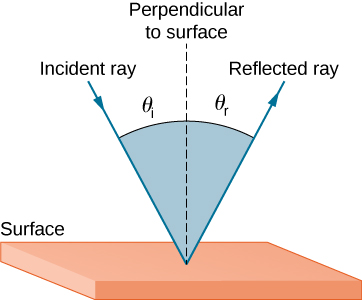
The light rays bounce off that flat surface with angle of reflection equal to angle of incidence. The law of reflection is illustrated in Figure 1 which also shows how the angles are measured relative to the perpendicular to the surface at the point where the light ray strikes. View Full Video Already have an account.
What is the law of reflection and what does it apply to. Want this question answered. 3 the incident ray and the reflected ray lie on either side of the normal.
Data tables 1 2 2. But still the law is applicable. Does it apply to rough surfaces as well as smooth.
The Law of Reflection tells us that when light strikes a reflecting surface the reflected light ray bounces off the surface at the same angle as it strikes the surface. What is the law of reflection. But it works because on a curved surface you must draw a tangent to that surface at the point the light ray is striking it.
No The law of reflection doesnot apply on rough surfacesBecause Reflection doesnot occur on rough surfaces. Specular Regular Reflection Regular reflection is where light is reflected off a smooth surface. For rough surfaces the law of reflection remains valid.
But when many rays strike an irregular surface the direction of reflected rays is widely different and you wont get the same effect as you get by the reflection of light by plane mirror. Does the law of reflection apply to all surfaces Get the answers you need now. The principle that when a ray of light radar pulse or the like is reflected from a smooth surface the angle of reflection is equal to the angle of incidence and the incident ray the reflected ray and the normal to the surface at the point of incidence all lie in the same plane.
The reflected ray is always in the plane defined by the incident ray and. The hatched vertical line on the left represents the plane mirror. Be notified when an answer is posted.
Give an example of each. 2 Distinguish between regular and irregular reflection. 3 Why is light refracted when it passes from one medium into another.
Click to see full answer. 4 Is an image formed by reflection real or virtual. Hello I need the following done in a lab report for Physics 2 algebra based.
Does the law of reflection apply to rough surfaces. Where is it located. Who are the experts.
What is the law of reflection and does it apply to all reflecting surfaces. Yes it is applicable for every single ray that falls on the irregular surface. The next piece over is tilted just a little differently but with respect to that local tangent its still angle of.
The law of reflection also holds for non-plane mirrors provided that the normal at any point on the mirror is understood to be the outward pointing normal to the local tangent plane of the mirror at that point. A What is the law of reflection and does it apply to all reflecting surfaces. The law of reflection defines that upon reflection from a smooth surface the angle of the reflected ray is equal to the angle of the incident ray with respect to the normal to the surface that is to a line perpendicular to the surface at the point of contact.
Does the law of reflection hold for curved mirrors. Light always reflects according to the law of reflection regardless of whether the reflection occurs off a flat surface or a curved surface. We review their content and use your feedback to keep the quality high.
Kolhan university Answer According to the laws of reflection 2 the incident ray the reflected ray and the normal lie in the same plane. Experts are tested by Chegg as specialists in their subject area. Yes the Law of Reflection holdsit is a law after all.
From that tangent you draw your normal and voila. Log in Narayan H. From that tangent you draw your normal and voila.
For the questions part only answer the ones below. Yes the Law of Reflection holdsit is a law after all. It predicts that rays incident at slightly different points on the surface are reflected in completely different directions because.
Does it apply to rough surfaces as well as smooth. It is on reflection and refraction of light. Answered Does the law of reflection apply to rough surfaces 1 See answer Answers.
If the reflecting surface is very smooth the reflection of light that occurs is called specular or regular reflection. Since the light strikes different parts of the surface at different angles it is reflected in many. 1 What is the law of reflection.
View the full answer. Give an example of each.
1 3 The Law Of Reflection Physics Libretexts

The Law Of Reflection Matthew Muraca Site

Does Diffuse Reflection Obey The Law Of Reflection Quora
No comments for "Does the Law of Reflection Apply to All Surfaces"
Post a Comment